
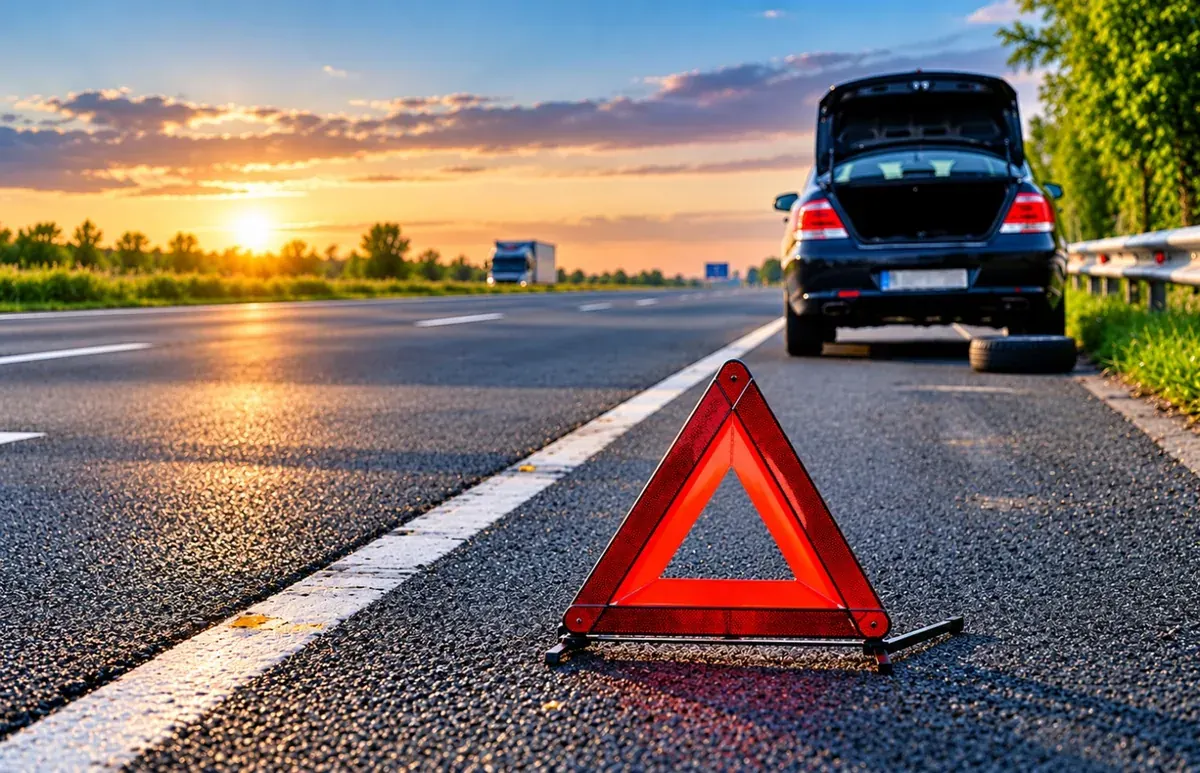
On the Sixth and Seventh Ring Roads, the Fahaheel Expressway and King Fahd Road, traffic passes you at well over 100 km/h. That is why the most dangerous part of a highway breakdown is not the fault itself but the first few minutes after it: where you stopped, where you stand, and how long you stay exposed to passing cars.
This guide does not repeat the general advice. It focuses on what is specific to Kuwait's highways: summer heat, driving at night, dust, and exactly what to tell the tow truck so it reaches you first time. For the basic steps, read our guide What to do when your car breaks down first.
The first 60 seconds: decisions that matter
1. Don't wait for the car to stop completely
At the first sign of trouble — a strange noise, a sudden loss of power, or a red warning light — switch on your hazard lights immediately, signal, and move gradually to the far right. Never brake hard in the left lane.
2. Choose where you stop, if you can
If the car is still driving safely, the best option is the nearest exit or petrol station. If that is not possible, stop on the right-hand hard shoulder, as far from the lane line as you can. Stopping by the central barrier on the left puts you between two fast lanes, so avoid it whenever you have another choice.
3. Secure the car
Apply the handbrake, turn the front wheels away from the road, and keep the hazard lights on for as long as you wait.
4. If you are stuck in a live lane
If your car stops in a busy lane and you cannot get out safely, do not try to walk across the lanes. Stay in your seat with your seatbelt on, keep the hazard lights flashing, and call 112 straight away.
Where should you and your passengers stand?
- Get out on the side away from traffic — usually the passenger side when you are on the right-hand shoulder.
- Move behind the crash barrier if there is one, and away from the car. Never stand between the car and the road, or directly in front of or behind it.
- Children first: take them out on the safe side and hold their hands the whole time.
- Don't push the car on a highway, and don't try to fix the fault close to traffic.
Breaking down in the summer heat
Summer temperatures in Kuwait can pass 50°C, and the inside of a parked car with the AC off heats up within minutes.
- Never leave a child or an elderly person in the car, even for a few minutes.
- If the car is parked somewhere safe, away from the lanes (a petrol station or car park), and the engine still runs, you can wait with the AC on. On a highway shoulder, getting away from the car and behind the barrier always comes first.
- Find shade, drink water and cover your head.
- Never open the radiator cap while the engine is hot — boiling coolant can cause serious burns.
- If anyone feels dizzy, has a severe headache or feels sick, call 112 without delay.
Breaking down at night
- Keep the hazard lights and sidelights on, and dip your headlights so you don't dazzle oncoming drivers.
- Wear a reflective vest if you have one, or use your phone torch so others can see you.
- Place the warning triangle well behind the car — only if you can reach that spot safely. Never walk into highway lanes to put it down.
Breaking down in a dust storm
On dusty days visibility can drop to a few metres, and an approaching driver will see you late. Move further from the road than usual, keep the hazard lights on, and close the windows if you are waiting inside a car parked somewhere safe. Anyone with asthma or allergies should wear a mask.
Broken down on the highway right now?
Send your live location and direction of travel — 24/7 tow trucks and flatbeds across Kuwait
What to tell the tow truck so it finds you first time
The most common cause of delay on highways is the wrong direction: if the driver arrives on the opposite carriageway, a long U-turn may be needed. Have this ready before you call:
- Road name and direction: for example, "Sixth Ring Road towards Jahra, after exit so-and-so".
- Live location on WhatsApp, not just a pinned location.
- Vehicle type: regular car, 4x4, lowered sports car or electric — so we send the right flatbed.
- Its condition: won't start, starts but won't move, accident damage, or a damaged tyre with no spare.
- Destination: home, the dealer, or your usual workshop.
Signs you should not keep driving
Some faults look minor, but driving on can turn them into an expensive repair or put you in danger:
- A red temperature light, or steam from the engine.
- The oil pressure light, or a knocking sound from the engine.
- A soft brake pedal, or metal grinding when you brake.
- A blowout with no usable spare, or a damaged wheel rim.
- Smoke or a burning smell: move away from the car at once and call 112.
In these cases the safe answer is a hydraulic flatbed that carries your car without it moving on its wheels. If the only problem is the battery, we offer jump starts, and if you have a spare we change the tyre where you are.
When the tow truck arrives
- Check it is the truck you booked: ask the driver for your name and destination before handing over the key.
- Agree the price before loading — we always give you the final price before we start.
- Photograph your car from every side before loading, and keep your valuables with you.
- Stand clear during loading, away from the straps, winch and flatbed, until the car is fully secured.
An emergency kit that solves half the problem
- Enough drinking water for everyone, especially in summer.
- A phone charger or power bank — your phone is your line to the tow truck.
- A reflective warning triangle and a reflective vest.
- A torch and a small fire extinguisher.
- An inflated spare tyre — check its pressure once a month.
Frequently asked questions
Should I stay in the car or get out on a highway?
If you have stopped on the hard shoulder and can get out on the side away from traffic, get out and wait behind the barrier. If you are stuck in a busy lane and cannot get out safely, stay in your seat with your seatbelt on and hazard lights flashing, and call 112.
Do you come out to ring roads and highways?
Yes. We cover ring roads and highways in every governorate of Kuwait, 24 hours a day. Send your live location on WhatsApp to 60601740 along with your direction of travel, and we will tell you the expected arrival time.
How is a broken-down electric car moved?
An electric car should only be moved on a hydraulic flatbed with its wheels off the ground, because towing it on its wheels can damage the drive system.
I have a blowout but I have a spare. Can you fit it?
Yes. We fit your spare in place of the damaged tyre where you are. If you have no usable spare, we take your car on a flatbed to the nearest tyre shop.
How much does a tow from the highway cost?
The price depends on distance, vehicle type and time of the request. We tell you the final price before we set off, with no hidden fees.
24/7 tow trucks and flatbeds across Kuwait
Every ring road and highway · modern hydraulic flatbeds · a clear price before we set off